Ptfe Fox Oil Necessar?
Add to Favorites Added to FavoritesThis week on the Tuesday Tune we're delving into suspension fluids to discuss some of the demands placed on them and how the manufacturers develop the properties that are necessary to meet these demands. Since we at aren't chemists, we invited Alex Marangoni, Canada Research Chair, Professor of Soft Material Sciences at the University of Guelph and the scientist behind to explain a few things to us:1.
What the major demands on suspension fluids typically involve2. What base oil types are used and their properties3. Some of the compromises involved in oil design4. How oil properties change with temperature and over timeFrom the workshop's point of view for servicing, we consider three main factors in the most relevant priority order when selecting an oil for a given application:1.
Viscosity - how thick the oil is, and its resistance to flow through shear2. Viscosity Index - the thermal stability of the oil and ability to minimise changes in viscosity as temperature changes3. Lubricity - its ability to reduce friction.Each of these factors has to be considered in terms of its relevance to the oil's application.
For example, fork splash bath lubricant needs to lubricate first and foremost, and forks in general are more sensitive to stiction than rear shocks as the rear shock has the leverage of the suspension linkage to help overcome its friction. Conversely, rear shocks see more heat than forks, so thermal stability becomes a bigger concern.Following those three primary considerations are secondary considerations, in no particular order:1. Oil durability - oil breakdown through thermal and shear stress occurs over time.2. Environmental concerns (side note - WPL's oils are biodegradable and non-toxic. But they taste terrible and eating or cooking with them is still generally not recommended)3. Anti-foaming characteristics (for open bath/emulsion dampers only)5.
Other factors affecting performance such as adhesive additives ('tackifiers') that can drag oil past seals. That particular case is more to do with the fact that the Emerald's damper is open bath - these always require a lot more oil than sealed cartridge dampers like the Boxxer and 40 use. In many cases there are limitations on how much oil you can physically fit in the fork lowers before the fork would have issues with hydraulic lock, or at the very least excessive pressure build up. Any forks where the bottom of the stanchion is sealed off for any reason will run relatively little oil in the lowers. Alex here.so, here comes the geeky answer. There is a parameter the scientists like Hildebrand and Hansen developed which characterizes the 'chemical nature' of a polymer (elastomer).
They were interested in predicting if a certain polymer was soluble in a particular solvent. The treatment is not difficult and it comes down to 'like dissolves like'. Like water does not dissolve oil but a mineral spirit does.
So, if the chemical nature of the solvent is similar to the polymer.wham.it starts swelling and eventually dissolving, losing tensile strength, going to hell. What you could also do is washing out 'plasticizers' which are added to the polymer to make them nice and soft and then your seals turns hard as a rock.not good.So, here it comes.if the absolute difference in HIldebrand solubility parameter between the polymer (elastomer) and the solvent (suspension oil) is greater than 2, then they are compatible. This is based on experience and testing.Now, which elastomer you say. Let's assume that all seals are made of NBR (Nitrile butadiene rubber under trade names such as Nipol, Krynac and Europrene), there is NO PROBLEM AT ALL since this elastomer has a solubility parameter of greater than 20, while WPL oils have a solubility parameter of about 15-17. So, we are all good.
Having said this, let's pay tribute to mineral oils and PAOs which have Hildebrand Solubility paramters around 10.However, this analysis will depend on the type of polymer that you use.natural rubber (NR), styrene-butadiene rubber (SBR), epoxidized natural rubber (ENR), ethylene propylene diene monomer (M-class) (EPDM). You could just look up the value of the respective polymers and judge by yourself (all in interenet). But I think most manufacturers are using nitrile rubber, so, we can pretty much be cool about the whole thing. If we are talking about natural rubber.then we may have problems.Does this help? : yes it does, thanks!
I feel kind of lucky that I studied material science back in the days!Next question would be what is made of what in a fork?Orings are most likely NBR as you mention. Bushings seems to be made of PTFE. Dust seals from SKF (or Fox, RS and racing Bro) are made of NBR.PTFE has a Hildebrand parameter of 6.2 which is then close to mineral oils and PAOs. But maybe 6.2 to 10 is enough? And maybe these 2 are not so common in suspension fluids?What about the other components of the suspension oil like detergents, tackifier, VI improver, lubricants, etc.? Would they have similar Hildebrand parameters as NBR or PTFE?
Fox Rhythm 34 Oil Change
: Are bushings made from PTFE? When I looked at the bushings in my forks (Magura) I just thought these were made from POM. POM has a good chemical resistance (also used in cigarette lighters) and good lubrication (used as gears in kitchen appliances etc)so it thought that was a fair guess.
But I didn't even think of PTFE. Then again I don't even know what PTFE looks like. My bushings are white.
Teflon tape used for gas fittings in plumbing is white too but teflon in pans for cooking is black. Or does bushing material just vary a lot between brands?
Fox Fit4 Damper Service
Awesome video. One question: Currently it's winter in the northern hemisphere and the temperatures can get very low, right now it's about -10째C in my country or even less. My fork (Manitou Mattoc Pro) is really sluggish in temperatures below 0째C. I can only use half of the travel and the rebound is slower. Is this normal with low temperatures? Obviously the problem is in the oil.
Ptfe Oil Treatment
On a long descent the oil warms up and it works great again. What do you recommend doing (specific type of oil?), so I can get quality performance from suspension in winter weather? Not being a seal designer I can't say for sure, but in an ideal world they would be. Seals are imperfect at the best of times though - if you have more seal squeeze and therefore better sealing capacity, you increase friction and seal wear. In cases where you have relatively consistent or steady state movement and oil pressures (think car engines/transmissions) then you can begin to factor in seal lubrication to the design, but in cases with extremely erratic motion such as suspension, I can only imagine that would be extremely difficult to do. Alex here.so, here comes the geeky answer.
There is a parameter the scientists like Hildebrand and Hansen developed which characterizes the 'chemical nature' of a polymer (elastomer). They were interested in predicting if a certain polymer was soluble in a particular solvent. The treatment is not difficult and it comes down to 'like dissolves like'.
Like water does not dissolve oil but a mineral spirit does. So, if the chemical nature of the solvent is similar to the polymer.wham.it starts swelling and eventually dissolving, losing tensile strength, going to hell. What you could also do is washing out 'plasticizers' which are added to the polymer to make them nice and soft and then your seals turns hard as a rock.not good.So, here it comes.if the absolute difference in HIldebrand solubility parameter between the polymer (elastomer) and the solvent (suspension oil) is greater than 2, then they are compatible. This is based on experience and testing.Now, which elastomer you say. Let's assume that all seals are made of NBR (Nitrile butadiene rubber under trade names such as Nipol, Krynac and Europrene), there is NO PROBLEM AT ALL since this elastomer has a solubility parameter of greater than 20, while WPL oils have a solubility parameter of about 15-17.
So, we are all good. Having said this, let's pay tribute to mineral oils and PAOs which have Hildebrand Solubility paramters around 10.However, this analysis will depend on the type of polymer that you use.natural rubber (NR), styrene-butadiene rubber (SBR), epoxidized natural rubber (ENR), ethylene propylene diene monomer (M-class) (EPDM). You could just look up the value of the respective polymers and judge by yourself (all in interenet). But I think most manufacturers are using nitrile rubber, so, we can pretty much be cool about the whole thing. If we are talking about natural rubber.then we may have problems.Does this help? While I'm inclined to agree with you (the negative chambers we use are proportionally the biggest in the industry as far as I'm aware) there are limitations to that too. As negative chamber size increases, so does the pressure requirement, which means you then need a larger positive chamber to avoid excessive ramp up (which is why we recommend going down a size in volume spacer if you install one of our Corsets or dropping a couple of tokens if you install a Luftkappe).
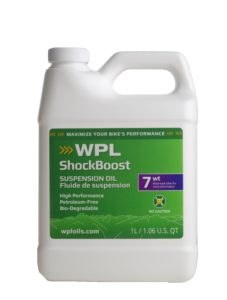
Eventually you run out of space, or have chambers so large that they weigh too much (as air can diameter goes up, so does the required wall thickness), and/or people are running the kind of pressures that create neutron stars etc. I can't speak for other companies' rationale, but we use WPL oils in all fork services and certain shock services now, including revalving & custom work, simply because they're the best lubricants we've found in terms of reduction of friction. Fox's 20wt gold is also great as a lubricant, on par with ShockBoost 20wt for friction, but we find its adhesive qualities mean that it gets drawn past seals quicker than the WPL equivalent (Fox and several others actually had to redesign their wiper seals when they released the 20wt Gold for this reason).
As a damping oil, it's great in forks, and suited to certain shocks but not so well suited to others.As for how well tuning services work, that is not a realistic generalisation that can be made. Some make a world of difference, some are a complete joke; some are very arbitrary guesses and some are well measured. The end result to the rider depends on how well developed the tuning method is, how well the tuner has managed to interpret the needs of the rider - that one is an art form in itself - and how capable the tuner is of creating measured and quantifiable changes to meet the rider's needs.
Jan 12, 2018 - The Pacific States are a group of five US states located along the coast of the Pacific Ocean. The most commonly accepted definition of the Pacific Coast is largely a political one: it defines the region as comprising the U.S. States of California, Oregon,. Western united states. The West Pacific States form one of the nine geographic divisions within the United States that are officially recognized by that country's census bureau. Five states form the Pacific States region of the United States - Alaska, California, Hawaii, Oregon and Washington - and, as its name suggests, they all have coastlines on the Pacific Ocean (and are the only states that border that ocean).

Read between the lines of anyone's marketing spiel, including ours, and you'll usually be able to get an idea of what you're really getting. This is definitely an industry in which skepticism is warranted.