Remove Static In Audacity
Have you ever recorded a vocal track in Audacity only to notice that your recording has a ton of white noise in it? For those who are not aware, is a type of noise that can drown out the main voices. It’s a common problem. Most consumer-grade microphones that are available have terrible sound pickup. This kind of thing can be quite annoying!How do you fix it? Well, you could go out and buy a better quality microphone (which you should probably do), or you could do a quick trick to make Audacity remove all of the unwanted white noise that regularly shows up on your tracks during recording. How to remove white noise from audio in AudacityRemoving white noise from audio tracks is a really simple process.

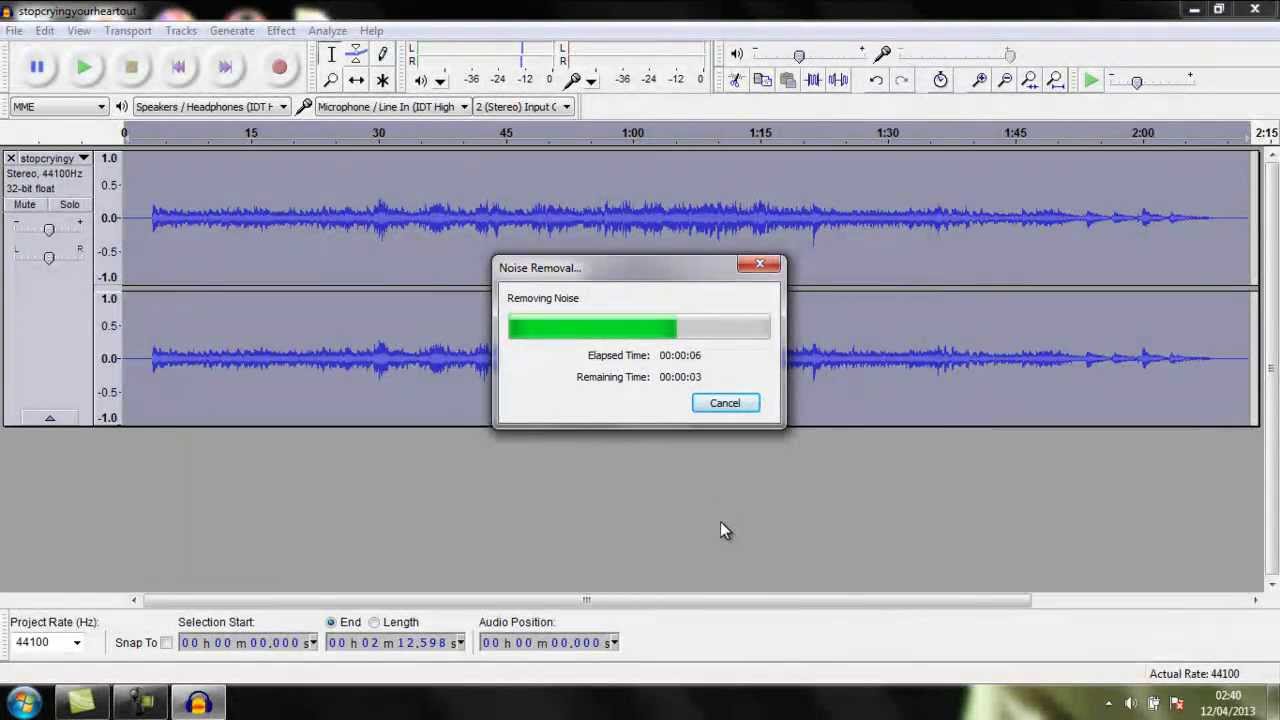
It only really requires a few steps to accomplish. For starers, you’re gonna need to get the white noise sound alone. It needs to be isolated. You’ll have a better chance of getting rid of it if you get a clear recording of it.Accomplishing this shouldn’t be hard work. Just record some audio with Audacity and don’t say anything into your mic. Let it go for a couple of seconds (thirty at most) for best results.Once you have your white noise recorded, select it using your mouse. Then go into the “Effect” drop-down menu and look for the “Noise Removal” option.
Click this and you will be brought straight into Audacity’s noise removal feature.Inside the noise removal window click the “Get Noise Profile” button. This will make Audacity take note of your white noise and save it temporarily.After that just go back to Audacity and record your vocals like normal. When you’re finished with your recording, go back into the “Effect” drop-down and into “Noise Removal.”From there, just click the “OK” button to start the removal process. Audacity will do a fairly good job of extracting the white noise from your recorded track. It’s not 100% perfect, but it does work well if you have a white noise issue you’re looking to get rid of.Note: Don’t worry about tweaking the settings in Noise Removal as the defaults work best. Make your audio sound even betterHere’s a quick trick to make your audio sound a little bit better.
Select your entire track with “Ctrl + A,” click the “Effect” drop-down menu and click on “Normalize.” When you do that, you’ll see a little pop-up selection menu appear. Just click the OK button to start the process. If you record quiet audio, it’s probably a good idea to normalize your tracks. When you do it, it allows you to make the overall track louder without changing it’s dynamic range. It’s a neat little trick, and it’ll help you out a lot if you’re a frequent Audacity user.
ConclusionWhite noise can be a real pain when recording, so it’s really great that it can be easily removed with the help of a simple feature within Audacity. You shouldn’t rely on this feature, though, because it’s not perfect. That being said, it has gotten me out of a lot of tight spots. I hope it’ll help you as well!Do you know of any Audacity tricks?
Let us know in the comments below!
A loose plug, a faulty cable or a malfunctioning microphone can all introduce static into your audio recordings. Ideally, you should eliminate static during the recording process. However, if you've captured an audio recording that unfortunately contains static, and you don't want to rerecord it, you can remove or at least reduce it by using a digital audio editing program like Audition, Audacity or GoldWave. These programs get rid of static by analyzing its sound frequency profile, then removing these frequencies from the audio file. Use Adobe Audition's 'noise reduction' function to remove static from a recording. Open the audio file in Audition, then highlight a part of the recording that contains only static.
Right-click to select it and click 'capture noise reduction profile.' Hold the control key and press the letter a on your keyboard to select the entire audio file. Click the 'effects' tab, then double-click 'noise reduction (process).'
Move the 'noise reduction level' left or right to apply less or more of the effect. Click 'preview' to preview the altered audio. Then click 'OK' to apply noise reduction.Get rid of static using Audacity's Noise Removal filter. Open the file that contains static, then highlight a portion of the audio that contains only static. Select 'effect' in the top menu bar, then choose 'noise removal.'
Vedasara shiva stotram in tamil. If you look at the South Face, you will see a wedge-like scar in the center going straight down.It is a little inappropriate to distinguish or to discriminate between one face of Kailash and the other, but the South Face is dear to us because Agastya Muni merged into the South Face. Ravana went sliding down the South Face of Kailash. Then finally, Parvati managed to bring him out of being enthralled, and when Ravana reached the peak, Shiva just pushed him off with his feet. They say his drum was dragging behind him as he slid down and it left a furrow on the mountain all the way down.
Click 'get profile' to load the static into memory, then click 'close.' Select the entire audio file, then click 'effect' and 'noise removal' again. Drag the slider to determine how much of the static Audacity removes.
Audacity Remove Clicks
Click 'preview' to listen to the altered audio without changing it, then click 'remove noise' to get rid of the static. Run audio through GoldWave's 'Noise Reduction' feature to remove static from it. Open the file, then click and drag on the waveform to highlight a section of the file that only has static in it. Press the control key and the letter c on your keyboard simultaneously to copy the static to the clipboard.
Press the control key and the letter a together to select the entire waveform. Then click 'effect,' 'filter' and 'noise reduction.'
Remove Static In Audacity Mac
Click the radio button next to 'use clipboard.' Click the drop-down menu under 'presets' and select the level of noise reduction that you want to apply. Click the 'play' button to preview the audio, then click 'OK' to apply the changes.